UNESCO Launches 3D Digitization of Historical Artifacts in Ghazni
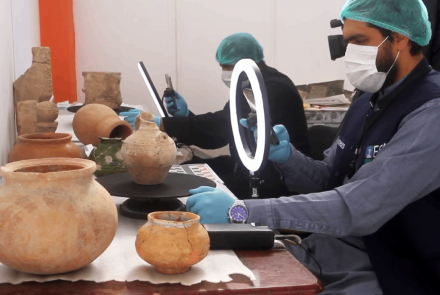
The United Nations Educational, Scientific and Cultural Organization (UNESCO) has launched a project to digitally document and create 3D models of ancient artifacts in Ghazni province.
According to local officials, UNESCO, in cooperation with a partner organization, has so far digitally and three-dimensionally scanned 450 historical and archaeological artifacts in the province. Officials say this effort will play a crucial role in preserving cultural heritage, preventing illegal trafficking, and reducing the risk of damage. It will also support academic research, proper documentation, and raise global awareness about these artifacts.
Hameedullah Nisar, Head of Information and Culture in Ghazni, said: “After the 3D digitization of these artifacts, a special website and virtual museum will be created. People from all over the world will be able to explore these artifacts through a dedicated system. This step will also greatly help in the preservation, restoration, and protection of the artifacts from smuggling.”
Ziarat Gul Ziarmal, head of the digital scanning team, said: “We scanned these artifacts in 3D, and a video will be made from it, which we will submit to the Ministry of Information and Culture. With the launch of a new website, the public will benefit from it.”
Meanwhile, cultural figures in Ghazni have welcomed the move, calling it a positive step toward supporting researchers and tourists, and have called for the continuation of this effort.
They also urged UNESCO and other aid organizations to help build a standard museum in Ghazni, where many valuable artifacts remain hidden in storage due to lack of exhibition space.
Agha Mohammad Khoshazada, a cultural activist in Ghazni, said: “UNESCO’s plan to digitize Afghanistan’s ancient artifacts is a very effective step. It will create facilities for researchers and tourists and also ease the work for museum staff.”
Mohammad Shafiq Yawari, Director of the Artifact Exhibition in Ghazni, said: “The Ghazni museum building is not up to standard. We call on UNESCO to support the construction of a standard exhibition hall and complex, as most of our artifacts are kept in storage due to lack of space.”
Ghazni is now the fifth province, after Kabul, Nangarhar, Logar, and Bamiyan, where UNESCO has launched the 3D digitization of historical artifacts.