Kabul’s District 13 Struggles with Water Shortages
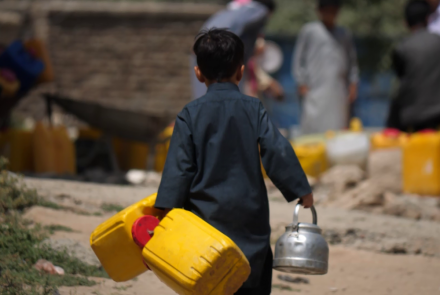
In Kabul, water is not just a liquid, it is a hope sought daily in long queues.
District 13 of Kabul is an example of other areas in the capital where life has become a challenge for residents. From small children to elderly men, everyone heads to the streets in search of a sip of drinking water.
From early morning, the lines begin, and everyone hopes to bring home a small share for their family before the water supply runs out.
Yar Mohammad, a resident of District 13, said: “I come here and take five barrels of water daily, and even that is not enough. Water consumption is very high. Previously, a 1000-Ltr barrel cost 40 Afghanis, now it’s 70 Afghanis ($1.1).”
Mohammaduddin, another resident of the area, said: “People should not waste water because the water level will drop, and it will harm them.”
Residents of this district are calling on officials to find fundamental solutions to their problems.
Bashir Ahmad, a resident of District 13, said: “We wander around looking for water. Our request from the government is to pay attention and provide facilities for us.”
Mohammad Faiz, a child from the area, said: “I come early in the morning until 11 o’clock. Sometimes our barrels are filled, sometimes they remain empty. We ask the government to help us with a public water tap.”
Meanwhile, water management experts emphasize that to solve this challenge, all national and international bodies and citizens of the country must act in coordination.
Najib Rahman Sadeed, a water affairs expert, said: “Governments, international organizations, the people, and private enterprises must all work in coordination to solve this problem. Projects such as transferring water from the Panjshir watershed, especially now that work is ongoing on the Baghdara Dam, can strengthen this process.”
The Ministry of Energy and Water also emphasizes that it has been able to properly manage and transfer water from the Qargha and Arghandi dams to Kabul. The ministry’s spokesperson added that they are also working to transfer water from the Shah and Aros dams to Kabul.
Matiullah Abed, spokesperson for the Ministry of Energy and Water, said: “The Ministry has a plan to transfer water from the Shah wa Arus Dam to Kabul. Fortunately, the cabinet of the Islamic Emirate has established a committee led by the Administrative Office, with relevant departments included, and technical work has begun.”
Earlier, the state-owned water supply company had inaugurated a project to produce and transfer water from the Qargha Dam to a 10,000-cubic-meter reservoir at Kabul Polytechnic University.