National Private Sector Conference Held in Kabul
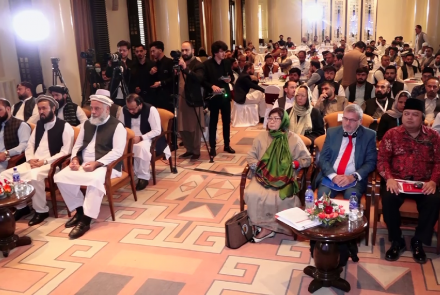
The National Private Sector Conference was held with the participation of officials from the Islamic Emirate, the European Union, and the United Nations.
The conference emphasized comprehensive support for small, medium, and large businesses in the country. Minister of Industry and Commerce, Nooruddin Azizi, said at the gathering that 193 projects are being implemented in cooperation with national and international institutions.
He urged these organizations to support long-term employment opportunities and fundamental projects across Afghanistan, giving priority to returning refugees.
Minister Azizi added: “The programs we are following are limited to specific provinces. We call on the representatives of international organizations present here to cover the whole of Afghanistan.”
Abdul Latif Nazari, Deputy Minister of Economy, stated: “Afghans who are skilled and return to the country can play a significant role in creating job opportunities.”
Organizers of the conference highlighted access to financial resources as a fundamental requirement for the growth of small and medium enterprises, stressing that addressing challenges faced by entrepreneurs must be a top priority.
Program director Sayedur Rahman Niazi noted: “We have faced challenges in domestic and foreign markets. Products are being produced, but we lack proper mechanisms for packaging, meeting standards, and exporting them to international markets.”
EU Chargé d’Affaires in Afghanistan, Erik Beumul, said: “At the moment, we actually have a significant portfolio of partnerships in support to private sector development and microfinance. We have a total of 60 million euros of active partnerships, which is part of our much larger investment in support to the people of Afghanistan..”
Similarly, UN representatives in Afghanistan highlighted the crucial role of small and medium-sized businesses in job creation, economic growth, and reducing dependency on foreign aid, calling for further efforts to support the private sector.
UN Secretary-General’s Special Representative for Afghanistan, Roza Otunbayeva, stated: “In past conferences, we pledged that each province should have a market for women and a representative of the women’s chamber of commerce. I have traveled across Afghanistan, but unfortunately, I have only seen such initiatives in Bamiyan, Maimana, and a few other places. In many new areas I visited, when I wanted to buy something, there were no markets available for women’s products.”
UNDP Director Stephen Rugers added: “In UNDP, we are working very closely with the government and with many of the partners to support MSMEs. Over the last few years, we have helped to start or strengthen over 80,000 businesses, including more than 70,000 that were led by women. And these businesses have helped to create hundreds of thousands of jobs.”
According to UNDP figures, small and medium-sized businesses account for about 80 percent of Afghanistan’s economy, with much of it managed by women and youth. However, only 20 percent of these enterprises have access to financial resources.