Herat Hosts First International Conference on Higher Education Quality
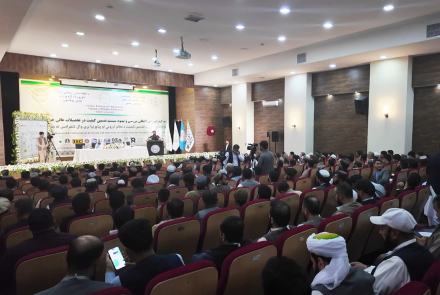
The first international conference on reviewing and improving quality assurance in Afghanistan’s higher education was held in Herat, organized by Jami University in cooperation with the Ministry of Higher Education.
Experts and researchers from the United Kingdom, Turkey, India, Bangladesh, Sri Lanka, Singapore, Uzbekistan, Pakistan, Iran, and Afghanistan participated in the conference.
Neda Mohammad Nadeem, Minister of Higher Education, said that in order to prevent un-Islamic ideas, reforms have recently been introduced in the country’s higher education curriculum, and this process will continue.
He stated: “In the coming days and months, you will see Afghanistan’s curriculum in such a way that nothing in it will harm the faith, morals, or mindset of Muslims. A healthy, reliable, and temporary curriculum will be presented to professors and students.”
Noor Ahmad Islamjar, Governor of Herat, said: “Industrialization of a country, a province, or a city is not only about bringing in machinery and factories, but also about raising an educated and knowledgeable young generation capable of managing these factories.”
At the conference, 65 academic papers, including 29 from international researchers, were presented.
The aim of this international conference was described as identifying and overcoming obstacles to improving the quality of higher education in Afghanistan.
Ateequllah Rahimi, Secretary of the International Conference on Quality Assurance in Higher Education, said: “There are still obstacles that, if resolved, can improve the quality of higher education in Afghanistan. These include weak infrastructure, a fragile economy, and a shortage of qualified academic staff in some universities. We suggest that the Ministry of Higher Education continue to support such national and international conferences.”
Meanwhile, some researchers and experts said Afghanistan’s higher education system requires fundamental reforms, and universities and the Ministry of Higher Education must work jointly in this regard.
They expressed hope that the Ministry would adopt the strategies discussed at the conference to address challenges facing higher education in the country.
Basir Ahmad Husain, a researcher and university professor, said: “The research findings of this conference should be made mandatory and applied by all Afghan universities, becoming part of their general procedures and mechanisms.”
Abdul Ghafoor Badpa, President of Chabahar International University of Iran, said: “Afghanistan will be one of the countries that will soon export knowledge. We have seen Afghan students in our country who are very eager to pursue education.”
Ismail Soyilmaz, a faculty member of Ankara University in Turkey, said: “Such conferences are very important and provide opportunities for the exchange of experiences and ideas between universities and countries.”
This international conference will be held over two days in Herat.
The Ministry of Higher Education has announced its support for every effort aimed at improving the quality of higher education and advancing modern sciences in universities.