Contagious Diseases Threaten Lives of Kunar Quake Survivors
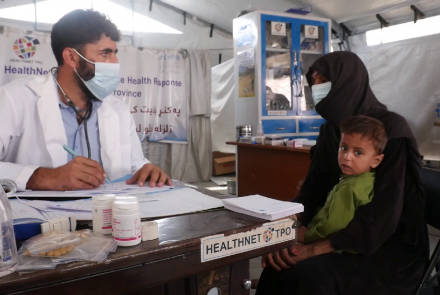
In Kunar, children from families affected by the recent earthquake have contracted contagious diseases due to poor living conditions, putting their lives at serious risk.
Jamala, who was displaced by last month’s devastating earthquake in Kunar, now lives with her 22-member family in a temporary shelter for earthquake survivors.
Jamala, a resident of Dewagal Valley in Chawkay district, said her house was completely destroyed in the earthquake. She added that her young grandchildren have recently fallen ill with infectious diseases, and she has brought them to a health center inside the temporary camp for treatment.
Jamala shared her story: “One of my grandsons is hospitalized in Jalalabad, and another one is sick here. He had stomach problems, so I brought him here for the doctor to check him and give him medicine.”
Several other earthquake survivors living in these temporary camps complained that their children have also become infected with various contagious diseases due to the unsanitary environment.
They are calling on the Islamic Emirate and aid organizations to take serious measures to prevent the spread of infectious diseases.
Another woman, Zarmeena, said: “My grandchildren are sick. It’s very difficult for us to live in tents. Some have stomach problems, some vomit, and others are suffering from seasonal illnesses.”
A father named Fareedullah added: “This is my son. He has caught a cold and fever and is very sick. We request that mosquito nets be distributed and more health facilities be provided so these diseases can be eradicated.”
Officials from the Kunar Public Health Department say that, in cooperation with the government and aid agencies, they have established several health centers for the earthquake-affected families, providing 24-hour medical services to ensure timely care.
Dr. Habibur Rahman Shirzad said: “Most cases we see are diarrhea, malaria, and children who come with blood in their urine. We provide them with treatment here.”
Kunar’s Public Health Director, Muzaffar Mokhles, also stated: “Our medical teams are distributing mosquito nets and providing health services to earthquake victims living in the mountains and tents in Dewagal and Mazar valleys, and even to those residing in their damaged homes.”
It is worth mentioning that the aid organization Save the Children reported that nearly 400,000 people in eastern Afghanistan, including more than 250,000 children, are in urgent need of humanitarian assistance.
According to the report, about 2,000 people were killed in the earthquake, over 8,000 houses were destroyed, and thousands of families were forced to live in tents, temporary camps, or among the ruins of their villages.