Continued Voting Ban, Uncertainty Over Afghanistan’s UN Seat
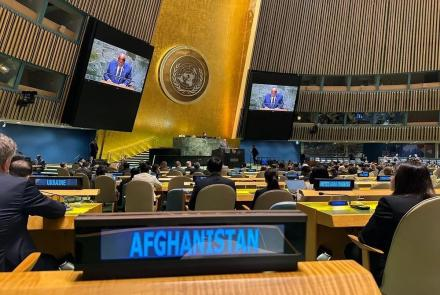
Nearly five years after the Islamic Emirate returned to power, the fate of Afghanistan’s permanent seat at the United Nations remains uncertain.
This seat has not yet been handed over to the current government through the official UN process by the “Credentials Committee.”
Over the past four years, the international community has set conditions for recognition, such as the formation of an inclusive government, respect for human rights, and efforts to combat terrorism and drug trafficking.
In response, the Islamic Emirate has described the formation of an inclusive government and the human rights situation as internal matters, while also assuring that Afghan soil will not be used to threaten others.
Political analyst Gul Mohammad Din Mohammadi said: “It is necessary for the United Nations to remove the names of current government officials from the blacklist and to release Afghanistan’s frozen assets. The Islamic Emirate should also show flexibility in some of its positions and accept certain global demands that do not conflict with our Sharia and values.”
Additionally, due to non-payment of its annual membership fee—amounting to $200,000—Afghanistan has been deprived of its voting rights in the UN General Assembly for the fourth consecutive year.
Before 2021, this fee was paid by the previous government, and Afghanistan’s debt has now exceeded $900,000.
The Islamic Emirate has made the payment of this debt conditional on the transfer of Afghanistan’s UN seat to the current government.
Former diplomat Aziz Ma’arij stated: “The United Nations, for specific reasons—including restrictions on girls’ education and women’s employment—has not handed over this seat to Afghanistan. In my opinion, this situation will continue until these challenges are resolved.”
The continuation of this situation has significant political consequences for Afghanistan; on one hand, the country’s role in global decision-making is limited, and on the other, the uncertainty over its representation complicates diplomatic engagement with the world.