Indian Envoy Urges Review of UN Sanctions on Afghanistan
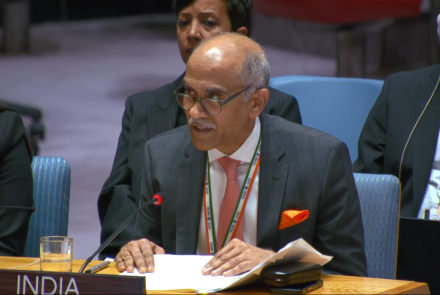
Parvathaneni Harish, India’s Permanent Representative to the United Nations, told a UN Security Council meeting on Afghanistan that the country’s political reality has changed over the past five years and “the current UN sanctions regime must take that into account.”
He said the United Nations and the international community need policy tools aimed at benefiting the Afghan people and steering policies in the right direction, rather than relying solely on punitive measures, which, according to him, are gradually losing their effectiveness.
Harish also condemned Pakistan’s airstrikes on Afghan territory and, citing a UNAMA report, said the attacks had resulted in significant civilian casualties.
He added, “Blaming neighbors for its own failures is an old Pakistani habit.”
The Indian envoy further accused Pakistan of imposing trade and transit restrictions on Afghanistan, arguing that blocking the trade routes of a landlocked country contradicts UN principles and declarations regarding landlocked developing nations.
According to Harish, this amounts to the instrumentalization of Afghanistan’s trade and transit vulnerabilities.
Meanwhile,Georgette Gagnon, Deputy Special Representative (Political) for Afghanistan in the United Nations Assistance Mission in Afghanistan (UNAMA), state at the meeting that Afghanistan remains stable under the current authorities and that there is no significant armed or political challenge to their rule. According to her, the Islamic Emirate considers this to be one of its most important achievements.
Gagnon added, however, that “The longer-term scenarios for Afghanistan, however, depend largely on internal dynamics within the de facto authorities’ governing structure,” and “for now, what exists is increasing control by the de facto authorities without a clear end-state.
Fu Cong, China’s Permanent Representative to the United Nations, also said that Afghanistan’s situation is currently stable. However, he said that challenges related to humanitarian assistance and counterterrorism remain complex and serious.
He emphasized that Afghanistan’s current authorities and the international community should move forward on a shared path with mutual trust in order to take effective measures for the well-being of the Afghan people and to ensure lasting stability in the country.
The UN Security Council meeting on Afghanistan was one of two meetings that UNAMA had previously announced. At the second meeting, scheduled for June 16th, the extension of UNAMA’s mandate will be discussed and reviewed.