Islamic Emirate Launches Five-Year National Health Strategy
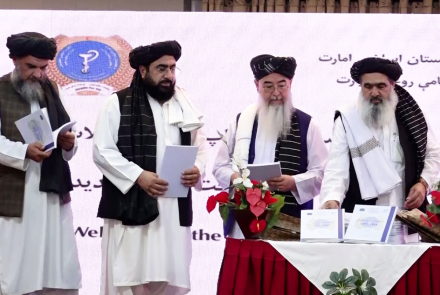
The Islamic Emirate’s Minister of Public Health has described the National Five-Year Health Strategy as an important step toward providing standardized and equitable healthcare services, improving the quality of healthcare, strengthening the capacity of health workers, equipping hospitals, and reducing maternal and neonatal mortality.
Speaking at the strategy’s launch ceremony, Noor Jalal Jalali argued that only a small portion of the assistance provided by international organizations is spent directly on Afghanistan’s health sector, with most of the funding being used by the organizations themselves. He also called on Afghan doctors living abroad to return and contribute to improving healthcare services in the country.
Jalali said: “Supporting domestic production is another key pillar of this strategy. Through its implementation, the production of medicines, vaccines, and other medical products will be encouraged, helping reduce Afghanistan’s dependence on other countries in this sector.”
Mohammad Hassan Ghiasi, Deputy Minister for Planning and Policy at the Ministry of Public Health, said: “The implementation of this strategy is a shared responsibility of all relevant government institutions, provincial public health departments, national and international health partners, donor agencies, implementing organizations, the private sector, academic and educational institutions, and the wider community.”
Meanwhile, Deputy Prime Minister for Administrative Affairs Abdul Salam Hanafi expressed concern over the lack of hospitals in remote areas of the country, saying the Islamic Emirate supports the Ministry of Public Health and is working to establish hospitals in all districts.
Hanafi said: “Islamic countries, friendly nations, United Nations agencies, and other organizations that have supported this sector can continue their assistance, as the people of Afghanistan still need this cooperation.”
Abdul Latif Nazari, Deputy Minister for Professional Affairs at the Ministry of Economy, stressed the importance of scientific and evidence-based planning that aligns with labor market needs.
He said: “Accurate, scientific, and academic planning based on labor market needs can help overcome unemployment while enabling us to use human resources as a social asset for the country’s progress, development, and prosperity.”
At the same event, Edwin Ceniza Salvador, the World Health Organization’s Representative in Afghanistan, acknowledged recent progress in the country’s health sector but said Afghanistan continues to face major challenges, including maternal and child mortality, malnutrition, communicable and non-communicable diseases, and mental health issues.
While reaffirming WHO’s continued support, Salvador stressed that Afghanistan’s Ministry of Finance should play a more active role in ensuring sustainable financing for the health sector.
He added: “At the same time, we must remember that this strategy is being implemented at a time when financial support from the international community and development partners is declining. The strategy also emphasizes the importance of the health workforce—both women and men—in achieving its priorities.”
According to the Ministry of Public Health, the National Five-Year Health Strategy consists of seven key components: governance and leadership, human resource development, sustainable health financing, healthcare service delivery, food, medicine and health products, health information systems, and coordination with donors and development partners.