Xi and Putin pledge closer coordination on Afghanistan issues
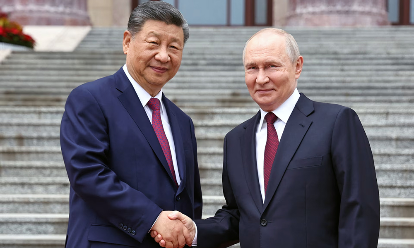
China and Russia have pledged closer coordination on Afghanistan, warning that terrorism remains a serious threat to regional and global security. The two nations also called for stronger international cooperation with Kabul.
In a lengthy joint statement issued during Russian President Vladimir Putin’s visit to China, Beijing and Moscow said they support Afghanistan’s efforts to eliminate terrorism and stressed that Afghan territory should not be used to threaten neighboring countries or the wider region.
The statement, released following talks between Chinese President Xi Jinping and Putin in Beijing, said both countries would deepen bilateral and multilateral cooperation on Afghan affairs and continue backing regional diplomatic platforms focused on Afghanistan.
China and Russia highlighted mechanisms as important channels for pursuing a political settlement and supporting long-term stability in Afghanistan.
“Both sides attach great importance to and support the positive and constructive role played by regional platforms such as the Foreign Ministers’ Meeting of Afghanistan’s Neighboring Countries, the Moscow Format consultations on the Afghan issue, the China-Russia-Pakistan-Iran Quad mechanism, and the Shanghai Cooperation Organisation in the political settlement of the Afghan issue,” the statement read.
The two sides also warned that terrorism continues to threaten Afghanistan and surrounding countries, urging regional states and the international community to expand counter-terrorism cooperation with Kabul.
According to the joint statement, both governments support Afghanistan in achieving “lasting peace and stability” and emphasized the importance of regional coordination in addressing security challenges.
The Afghanistan section formed part of a broader China-Russia declaration covering regional security, international conflicts, economic cooperation and opposition to unilateral sanctions.
The statement also addressed developments in the Middle East, Ukraine and the Korean Peninsula, while reaffirming support for multilateral organizations including BRICS and the Shanghai Cooperation Organisation.
According to the statement, both sides agreed that “the US-Israel military strikes against Iran violated international law and the basic norms of international relations, severely undermining stability in the Middle East.
They emphasized that the parties involved in the conflict should return to dialogue and negotiation as soon as possible to prevent the spread and spillover of the conflict.
They also called on the international community to uphold an objective and impartial stance, promote de-escalation, and jointly safeguard the basic norms of international relations.
In addition, both sides advocated for a lasting ce asefire in Gaza, believing it would contribute to long-term stability and provide unimpeded humanitarian access for all who need it.
“They affirmed that the Palestinian question should be resolved comprehensively, justly, and lastingly based on universally recognized international law and centered on the two-state solution, leading to the establishment of an independent, prosperous, and territorially complete Palestinian state that can coexist peacefully and securely with Israel,” the statement read.