Carpet Weaving Grows in Eastern Provinces; Women Make Up 90% of Workers
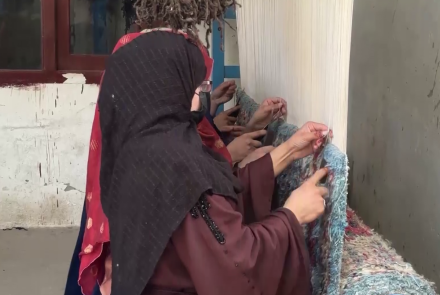
Carpet weaving is one of the traditional crafts practiced by Afghan women, which has maintained its place in the country’s handicraft industry despite economic challenges.
At a carpet-weaving center in Jalalabad, a number of women are busy weaving carpets, each of which requires months of time and effort to complete.
Nazia, a carpet weaver in Nangarhar, said: “We come to work every day at 8 a.m. and work until noon. Here, we produce yarn and receive 100 afghanis for every kilogram of yarn we make. Our trainees are also working here, and they receive 70 afghanis for each kilogram of yarn they produce.”
Hajira, another carpet weaver, said: “Twenty female workers work with me in yarn production. They produce high-quality yarn from wool. Another 20 female workers are involved in carpet weaving. Here, we produce prayer rugs, decorative wall hangings, and carpets. We make products of both high and lower quality according to customers’ demands.”
Currently, 35 large and 45 small carpet-weaving centers operate in the country’s eastern provinces, employing thousands of people. Women account for 90% of the workers at these centers.
Officials of the Carpet Weavers’ Union in the eastern provinces are calling for cooperation from relevant institutions and aid organizations to expand activities in the sector and create more job opportunities.
Abdul Hamid Safi, a factory manager in Nangarhar, said: “We want a permanent market for our products and an open space for exhibitions, where there are shops and where we can display our products. This would also make it easier for customers, whether local buyers or foreign traders, to come here and choose the carpets they want. Currently, when foreign traders visit, we take them to Kabul and show them our products there. Foreign traders do not come to the eastern provinces at all.”
Hikmatullah Safi, head of the Eastern Zone Carpet Producers and Exporters Union, added: “In 1404, around 1,600 tons of carpets worth five million dollars were exported from the eastern provinces to foreign countries. It is estimated that this year, around 2,200 tons of carpets worth nine to ten million dollars will be exported abroad.”
According to the Carpet Weavers’ Union in the eastern provinces, carpets produced in these provinces are exported to Germany, the Netherlands, France, Belgium, and Norway.
Officials from Nangarhar’s Department of Industry and Commerce have also assured carpet weavers of their support, including domestic marketing and the provision of facilities to expand their activities.
Mohammad Asif Elyas, spokesperson for the Ministry of Industry and Commerce, said: “The Ministry of Industry and Commerce fully supports the carpet-weaving industry in the country. The current position and progress of Afghanistan’s carpet industry are the result of joint efforts by the Ministry of Industry and Commerce and the carpet-weaving sector.”
Afghan carpets are among the country’s traditional handicrafts and cultural heritage. Known for their distinctive designs, beautiful colors, and quality, they hold a special place in international markets. This craft has been preserved from generation to generation, particularly by Afghan women.